
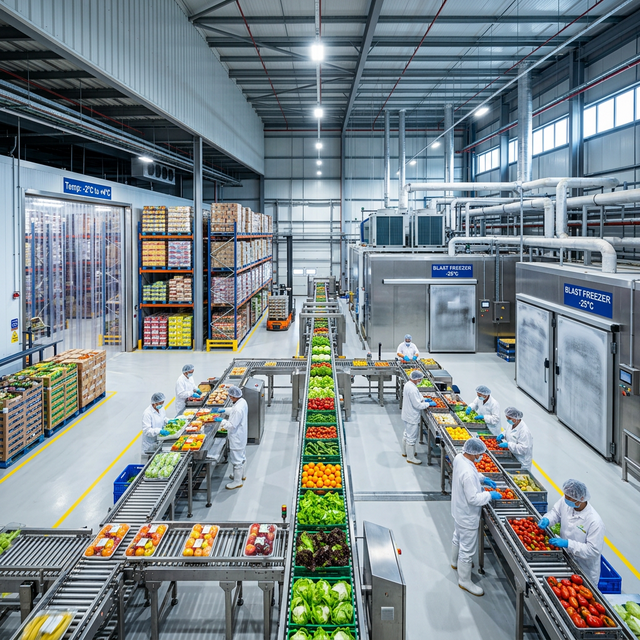
Shelf Life is an Engineering Outcome.
Not a Luck of the Cold Chain.
FSSAI and HACCP-ready processing and storage environments i.e., from blast freezing and controlled atmosphere to ambient dispatch i.e., engineered to maintain product quality and eliminate cold chain breaks.
India Loses Significant Food Production to an Inadequate Cold Chain.
Only a fraction of perishable food in India moves through an organised cold chain, compared to 70–80% in developed markets. This gap represents both a significant economic loss and an engineering opportunity. The root cause is not a lack of awareness i.e., it is a lack of correctly engineered first-mile and mid-chain infrastructure.
Modern food & beverage cold chain infrastructure goes far beyond simple refrigerated storage. It requires HACCP-driven process design, FSSAI-compliant hygienic construction, multi-zone temperature management, blast freezing capability for IQF products, ripening chamber automation, and energy-efficient systems that keep operating costs competitive while meeting increasingly stringent food safety regulations.
Multi-Zone Temperature Architecture
Six independently controlled zones covering the full F&B cold chain i.e., from ambient dry goods to ultra-low blast freezing.
Designed for Every Major Food Safety Standard
FSSAI Compliance
Food Safety & Standards Authority of India
- FSSAI License for cold storage and food warehousing operations
- Compliance with FSS (Licensing and Registration) Regulations, 2011
- FSSAI Schedule 4 i.e., sanitary and hygienic requirements
- Pest management programs with documented records
- Temperature and hygiene documentation for audit
HACCP System
Hazard Analysis & Critical Control Points
- Hazard analysis for all temperature-sensitive product categories
- Critical Control Points (CCPs) at receiving, storage, and dispatch
- Critical limits defined for each CCP (temperature, time, RH)
- Monitoring procedures with corrective actions for deviations
- Record-keeping system with 2-year minimum retention
BRC Global Standard
BRCGS Storage & Distribution
- Site security and food defense protocols
- Temperature monitoring with automated logging
- Allergen management and segregation procedures
- Traceability system i.e., 1-up, 1-down minimum
- Internal audit program with management review
ISO 22000:2018
Food Safety Management System
- Process-based approach aligned with PDCA and risk-based thinking
- Prerequisite Programs (PRPs) for infrastructure and maintenance
- Operational PRPs (OPRPs) for cold chain process control
- Documented food safety policy and objectives
- Continual improvement through management review
Blast Freezer & IQF Specifications
High-velocity air blast systems engineered for rapid product freezing with minimal ice crystal formation i.e., preserving texture, nutrition, and appearance.
Blast Freezer Technical Parameters
Specialized Processing Solutions
Beyond storage i.e., purpose-built environments for food processing, ripening, and pre-cooling.
Processing Halls
- Temperature maintained at +10°C to +12°C for meat/seafood processing
- HVAC with 100% fresh air option, HEPA pre-filtration
- Positive pressure to prevent ambient air ingress
- Stainless steel wall and ceiling cladding (304 grade)
- Resin-coated sloped floors with coved junctions for wash-down
- NSF-listed drainage (?"Cove-style 12" trench drains)
Hygienic Design Principles
Every construction detail engineered for cleanability, food safety, and regulatory compliance.
Energy Efficiency & Sustainability
Reducing energy consumption by 30-50% through smart design, natural refrigerants, and heat recovery i.e., without compromising food safety.
Energy Recovery Systems
- Desuperheater heat recovery: captures superheat from compressor discharge
- Hot water generation: 55-65°C water for wash-down and sanitation
- Energy savings: reduces boiler load by 20-30%
- Payback period: typically 18-24 months
VFD-Optimized Refrigeration
- Variable Frequency Drives on compressors, condensers, and evaporator fans
- Part-load optimization: 30-50% energy savings at 50% load
- Floating suction pressure control based on actual demand
- Floating head pressure control based on ambient wet bulb
Natural Refrigerants
- R-717 (ammonia): COP > 4.0, zero GWP, zero ODP
- R-744 (CO₂): cascade systems for ultra-low temperatures
- R-290 (propane): small charge systems for retail display cases
- Compliance with India's HFC phase-down schedule (Kigali Amendment)
Design Your Food & Beverage Cold Chain Facility
Get a comprehensive facility design with HACCP flow diagrams, temperature zone specifications, energy modeling, and project timeline.